Contact Us
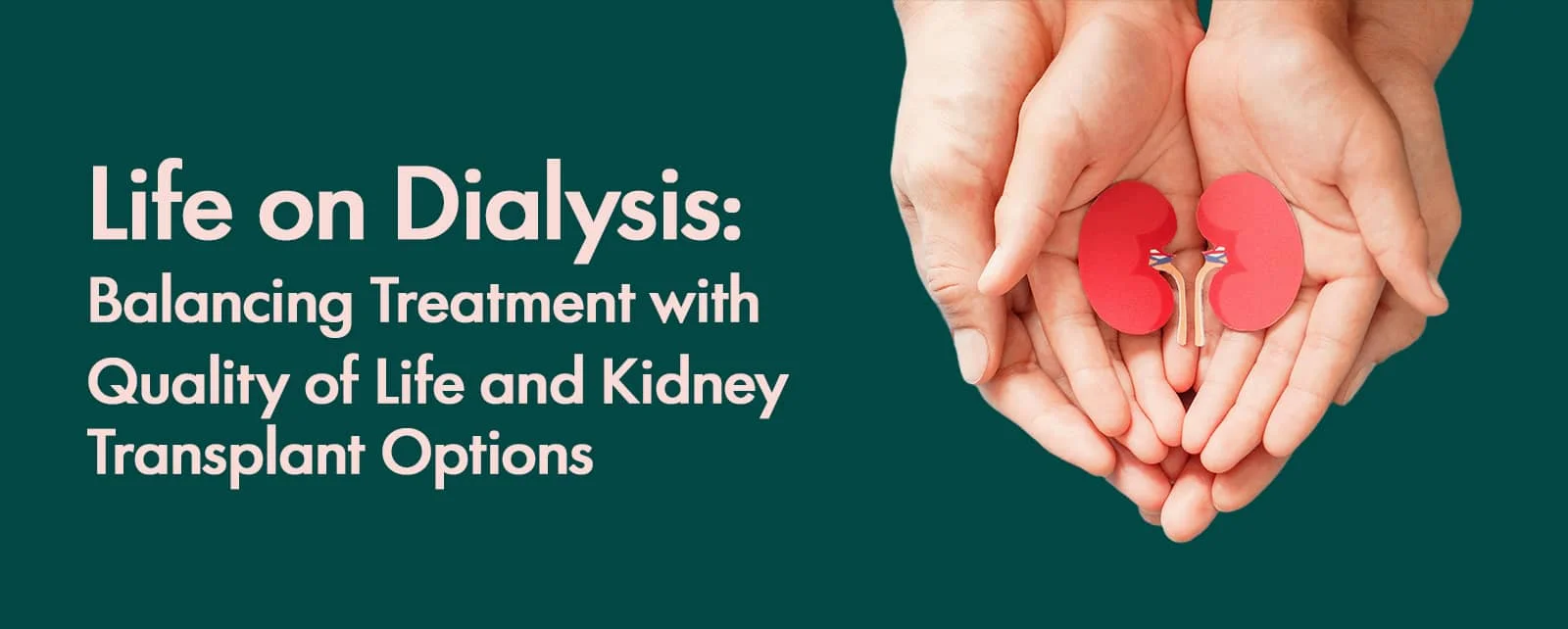
Life on Dialysis: Balancing Treatment with Quality of Life and Kidney Transplant Options
Most people's understanding of dialysis is somewhere around the level of a medical procedure that happens a few times a week and then you go home. Which is technically accurate and almost entirely misses what it actually means to be the person it is happening to. Because the thing about dialysis is not the sessions themselves, difficult as they are, it is what organises itself around the sessions. The schedule becomes the frame inside which everything else gets fitted. Social plans, family time, work, travel, sleep, all of it gets arranged in the gaps between three sessions a week rather than freely. You do not plan your life and fit dialysis into it. You plan around dialysis and fit your life into what remains.
This is not a complaint about the treatment. Dialysis keeps people alive who would otherwise die from kidney failure and that is not a small thing. But the gap between what dialysis does clinically and what it involves personally is large enough that people entering it for the first time are almost always surprised by how much it changes the texture of daily life and not just the schedule of it.
What the Kidneys Were Doing That Dialysis Has to Replace
Healthy kidneys do more than most people realise much later sometime till their own stops working. Kidneys filter blood continuously, manage waste products, regulate fluid and electrolytes, produce hormones that control blood pressure and tell the bone marrow to make red blood cells. When kidney function falls below about ten to fifteen percent of normal all of this starts failing together and the body accumulates what it should be eliminating.
Dialysis takes over the filtration part of this mechanically. Waste products and fluid get removed on a schedule. What dialysis cannot do is replicate the hormonal functions which is why patients on dialysis also need medication for anaemia that working kidneys would have managed automatically, and medication for blood pressure, and careful monitoring of electrolytes and bone mineral metabolism that a functioning kidney would have regulated quietly without anyone having to think about it.
End-stage kidney disease is not a single problem that dialysis solves. It is a collection of problems that dialysis addresses in part and that require additional management for everything the dialysis does not address.
The Restrictions That Do Not Get Enough Mention
Fluid restriction is the one that catches people most off guard. Not the idea of it, people hear fluid restriction and think they understand it, but the daily reality of tracking intake, of feeling thirsty and knowing that thirst cannot be fully answered, of calculating what is in food alongside what is in drinks, of the consequences when the restriction has not been maintained showing up as swelling and breathlessness and a difficult session where the machine has to work harder to remove what accumulated. It is a level of daily discipline that requires sustained attention and that gets harder not easier when life is complicated by other things.
Dietary restrictions around potassium, phosphorus and sodium are similarly specific and similarly unforgiving. The people who manage well on dialysis are the ones who have been properly educated about these restrictions and understand why they exist rather than having been handed a list of what to avoid without the reasoning that would make the list meaningful.
Quality of Life Is Not a Given, It Is Built
This is the thing that good nephrology care at a proper nephrology hospital in Delhi understands and that not all nephrology programmes make sufficient space for. Living well on dialysis is possible. Most patients who are well-managed, who engage actively with their care, who maintain their restrictions, attend sessions consistently and communicate changes in how they feel between sessions, do well in a way that would surprise people whose image of dialysis is entirely medical and not at all personal.
But it does not happen automatically. It is built through consistent effort from both the patient and the clinical team and it requires that the clinical team is doing more than providing technically adequate dialysis and nothing else. The psychological adjustment to being on long-term dialysis is as real as the physical one. There is loss in it. Loss of the body that worked differently, loss of the spontaneity that existed before every plan had to account for the schedule, loss of the version of life that did not require this level of daily medical management.
Acknowledging that loss rather than treating it as a separate non-medical matter is part of what good nephrology care actually looks like.
The Transplant Thing and Why It Cannot Wait
Kidney transplantation produces better long-term outcomes than dialysis for most patients who are suitable for it and the conversation about it should start as early as possible, ideally before dialysis begins rather than after the patient has been on it for a year and has adjusted to it as a permanent arrangement. A transplant that happens before dialysis is necessary at all produces better outcomes than a transplant that happens after a period of dialysis.
Getting to that pre-emptive transplant requires identifying a suitable living donor, completing the medical evaluation on both sides, and navigating the process while kidney function is declining but dialysis has not yet started. All of this takes time and the time has to be available to take.
Robotic kidney surgery in Delhi has changed the living donor conversation in a specific and practical way. Robotic and laparoscopic donor surgery produces much less pain after the operation, shorter time in hospital and faster return to normal life than open donor surgery with the same surgical results. Some people who were suitable donors but worried specifically about the recovery from open surgery have donated through the minimally invasive approach.
This matters in a situation where a willing and suitable donor is what stands between a patient and a transplant. For patients whose kidney disease is complicated by kidney stones, kidney stone treatment in Delhi at a centre where nephrology and urology work together on the same patient matters specifically. Stone management in people with chronic kidney disease or in transplant recipients is different from stone management in people with healthy kidneys and managing it well requires both specialties rather than each treating only their part of the problem.
Sri Balaji Action Medical Institute in Paschim Vihar has been running its nephrology and urology programme long enough and at a scale large enough that the full range of what kidney disease management involves, from conservative management through dialysis through transplant evaluation and support, is available within the same institution. For patients in Delhi who are on dialysis or heading toward it and trying to understand what the full picture of their options actually looks like, Action Hospital is where that conversation is worth starting.
FAQs
Q1. What does life on dialysis actually feel like day to day?
Very organised around the treatment schedule in ways that affect social plans, work, travel and sleep. Well-managed patients who take their restrictions seriously, attend sessions consistently and work with their nephrology team live full lives within those constraints. The constraints are real. So is the life inside them for patients who engage actively with their care rather than passively attending sessions.
Q2. How does robotic kidney surgery in Delhi make living donation more accessible?
By substantially reducing post-operative pain, hospital stay duration and recovery time compared to open donor surgery while producing equivalent surgical outcomes. Some suitable donors who were deterred specifically by the recovery from open surgery have donated through the robotic or laparoscopic approach. That changes the practical availability of living donors in a situation where donor availability is often the limiting factor.
Q3. What should a nephrology hospital in Delhi be providing beyond the dialysis itself?
Management of anaemia, blood pressure, bone mineral health and the other systemic complications that dialysis does not address on its own. Regular adequacy monitoring with prescription adjustment, proper dietary and fluid education, psychological support for the adjustment to chronic illness, and active engagement with the transplant pathway for suitable patients rather than treating dialysis as the endpoint of the conversation.
Q4. Why does the transplant conversation need to start early?
Because pre-emptive transplant, transplant before dialysis becomes necessary, produces better outcomes than transplant after a period of dialysis, and getting there requires time that has to be created by starting early. Identifying a suitable living donor, completing evaluations on both sides, navigating the process while still in the predialysis phase, none of this can be rushed and all of it takes longer than patients who start the conversation late have available to them.
Q5. What is specific about kidney stone treatment in Delhi for patients with chronic kidney disease?
The treatments that work straightforwardly in patients with normal kidney function carry different risk profiles in people with chronic kidney disease or transplant recipients. Managing it well requires nephrology and urology working on the same patient together rather than each treating only their part of the problem separately, and a centre where this coordination exists routinely rather than by exception produces meaningfully better outcomes for this specific patient group.