Contact Us
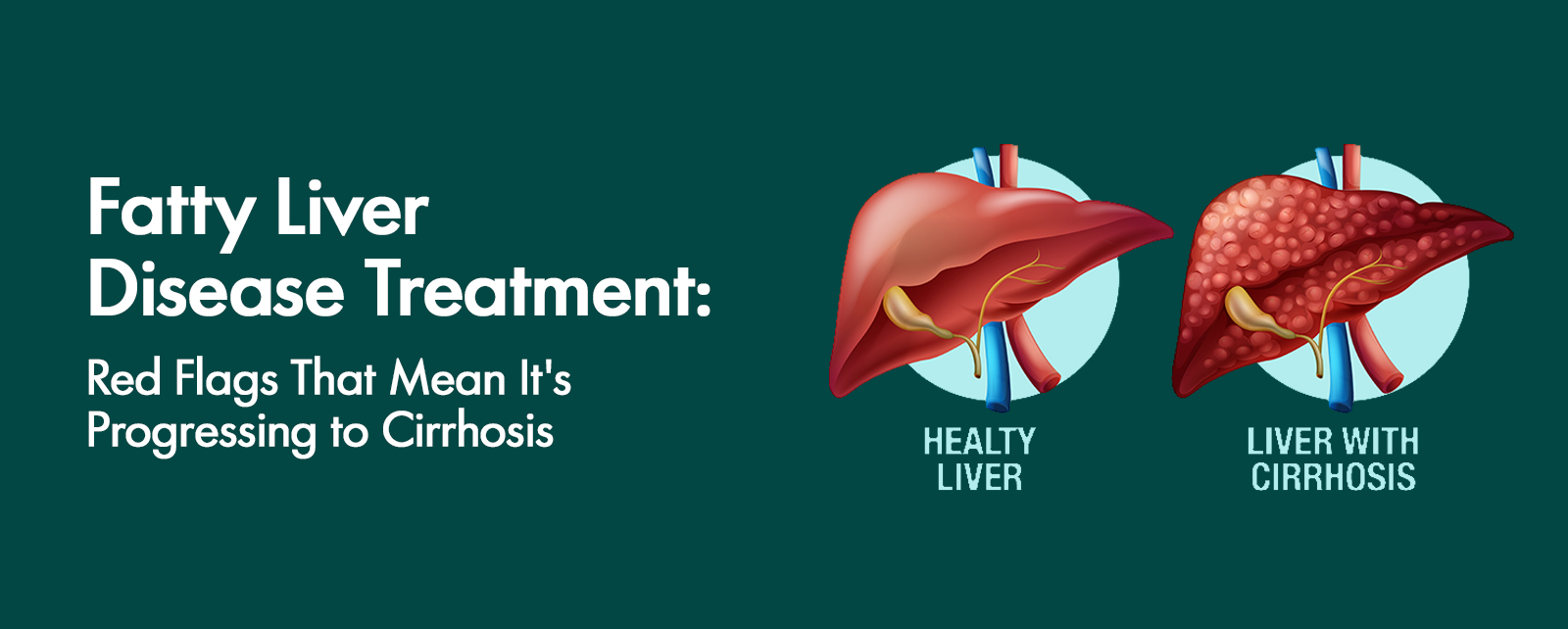
Fatty Liver Disease Treatment: Red Flags That Mean It's Progressing to Cirrhosis
Steatotic Liver Disease (SLD), which used to be called fatty liver disease, is one of the most common chronic liver diseases in India these days. A lot of the time, these patients are actually first found on a routine ultrasound done for some other reason. This liver condition needs to be taken seriously rather than simply dismissed as no big deal. In fact, the initial phase of the disease can be reversed by changing diet and exercise. Yet, if the risk factors are not controlled, the patients may develop liver inflammation, fibrosis, cirrhosis and liver cancer.
Fatty liver disease is a continuum with a subgroup of patients progressing to inflammatory and scarring stages that lead to cirrhosis - a condition of severe, virtually incurable liver fibrosis with dire effects such as liver failure and hepatocellular carcinoma. The best approach to breaking the cycle of fatty liver is to visit a liver specialist in Delhi as soon as the initial diagnosis is made, but not after the symptoms have advanced.
Continuum of Fatty Liver to Cirrhosis
Knowledge about the disease continuum can help patients understand why it is important to monitor the disease even in good health. Fatty liver disease has a pattern of pathology that is recognisable, but not all patients go through all the stages.
The steps occur in the following way:
- Simple steatosis, in which the fat deposits itself in the liver cells, without the addition of inflammation or cell injury - this stage can be corrected to a large extent with lifestyle change.
- Non-alcoholic steatohepatitis (NASH), in which the fat build-up is combined with inflammation and damage of hepatocytes, increasing the chances of fibrosis.
- Fibrosis, in which recurrent bouts of inflammation stimulate the deposition of scar tissue in the liver parenchyma, gradually substitutes functional liver cells.
- Cirrhosis, in which scarring is widespread, alters the architecture of the liver, hampering its regenerative potential and producing portal hypertension with all the accompanying complications.
A gastroenterology hospital in Delhithat caters to patients in this spectrum would employ a mix of liver function tests, elastography (FibroScan), and in some cases liver biopsy to accurately stage the disease and then determine the intensity of treatment.
Red Flags Which Indicate Progression Beyond Simple Fatty Liver
The fact that there are no symptoms does not prove that there is no progression. The liver disease is so infamously silent that, when fibrosis is complicated, the clinical observation is incomparable to symptomatic vigilance. With that said, there are some physical and biochemical symptoms that need to be evaluated by a specialist as soon as possible.
Clinical red flags that should be evaluated in a super speciality hospital in Delhi NCRare:
- Incessant exhaustion that is out of proportion to activity or sleep quality could indicate hepatic metabolic malfunction.
- Pain in the right upper abdomen or fullness in the right rib cage when the liver capsule is stretched.
- Weight loss without a change of diet or exercise.
- Jaundice, the yellowing of the skin or sclera, is a sign that the liver is no longer performing its bilirubin-processing job satisfactorily.
- Ascites, which is a characteristic of decompensated cirrhosis, is a manifestation of portal hypertension and decreased albumin production.
- Spider naevi - small, spider-like blood vessel lesions of the upper part of the body and palmar erythema, which are related to severe chronic liver disease.
- The impaired production of clotting factors by the liver leads to easy bruising or prolonged bleeding after small cuts.
- Dislocation, disorientation, or an altered personality indicate hepatic encephalopathy, a severe neurological complication of liver failure.
Biochemically, constantly high ALT and AST, a declining platelet count, decreased serum albumin, and an increasing INR are all indicators that depict a worsening hepatic reserve and which a liver specialist in Delhi would consider actionable red flags that warrant a quicker investigation.
What Treatment Would Be Like at Various Stages?
Fatty liver at the early stage can be treated well with a structured lifestyle intervention. It has been shown that a prolonged loss of body weight of 7 to 10 per cent can lead to a decrease in liver fat content, an improvement in liver enzyme levels, and reversal of early fibrosis in some patients. The clinical basis is dietary strategies based on a decreased-calorie Mediterranean-style pattern, the avoidance of fructose-rich processed foods, alcohol avoidance, and moderate frequency of moderate-intensity exercise.
Pharmacological efforts could be a resort for a few MASH and liver fibrosis patients, mainly in cases where lifestyle changes alone are not enough. However, the patient's drug therapy must always be tailored to the stage of their liver disease, metabolic profile, diabetes status, body weight, and other medical conditions. In actual practice, hepatologists per the different clinical settings, may suggest therapies like vitamin E for selected non-diabetic patients, pioglitazone for insulin-resistant people, GLP-1 receptor agonists such as semaglutide for patients with obesity or type 2 diabetes, saroglitazar for a few patients with metabolic dysfunction, and still newer drugs such as resmetirom for patients with non-cirrhotic MASH and fibrosis, guided by their specialist evaluation rather than independently.
Management at the cirrhosis stage changes to one of prevention and surveillance of complications. This includes:
- Hepatocellular carcinoma surveillance: 6-monthly liver ultrasound and AFP measurements.
- Endoscopy of the upper GI to identify oesophageal varices and commence prophylaxis where necessary.
- Frequent evaluation of liver synthetic activity to detect decompensation in a timely manner.
- Evaluation for liver transplantation candidacy in patients with end-stage disease.
Sri Balaji Action Medical Institute: Under One Roof Hepatology and Gastroenterology
Sri Balaji Action Medical Institute is a full-fledged Institute of Gastrosciences based in Paschim Vihar, New Delhi, with fields of medical gastroenterology, interventional gastroenterology, hepatology, and GI and HPB surgery. The gastroenterology and hepatology department, headed by Director Dr. Monika Jain, offers FibroScan-based liver evaluation, cutting-edge endoscopic evaluations, and tailored management programmes in fatty liver disease, NASH, cirrhosis, and portal hypertension. Sri Balaji Action Medical Institute is accredited by NABH and has attended to more than 20 lakh patients over 40+ specialities, and offers a depth of diagnosis and multidisciplinary infrastructure that progressive liver disease requires.
Conclusion
One of the biggest myths is that all fatty liver disease is harmless. Although a lot of patients may live with the disease without facing any major issues for years, there are those who, without even showing many symptoms, get sick with significant fibrosis of the liver. That is why early evaluation and regular check-ups are very important, mainly for people who have obesity, diabetes, high cholesterol, or metabolic syndrome.
Frequently Asked Questions
Q1. What does a liver specialist in Delhi do to tell the difference between fatty liver and fibrosis or cirrhosis?
FibroScan elastography, liver function tests, platelet count, and serum albumin are used to stage it. In case of inconclusive and contradictory non-invasive results, liver biopsy is the gold standard.
Q2. Is it possible to cure fatty liver disease using only medicines?
The answer is no. Treatment based on lifestyle changes is still the main approach. Besides losing weight, one should adopt healthy eating habits, exercise regularly, control diabetes, and refrain from alcohol. Given the seriousness of the disease and metabolic disorders, doctors may prescribe medicines to certain patients.
Q3. When can a patient be evaluated in a super speciality hospital in Delhi NCR, at what stage of fatty liver disease?
Patients who demonstrate constantly increased liver enzymes, F2 or higher FibroScan score, or whose condition is characterised by fatigue, stomach pain, or unexplained weight loss should be evaluated by a specialist immediately.
Q4. Does Sri Balaji Action Medical Institute have an evaluation of liver transplant for patients with end-stage cirrhosis?
Yes, the institute offers a full spectrum of hepatology services, such as cirrhosis treatment and transplant candidacy assessment, with the help of its multidisciplinary teams of gastroenterology, hepatology, and surgery.