Contact Us
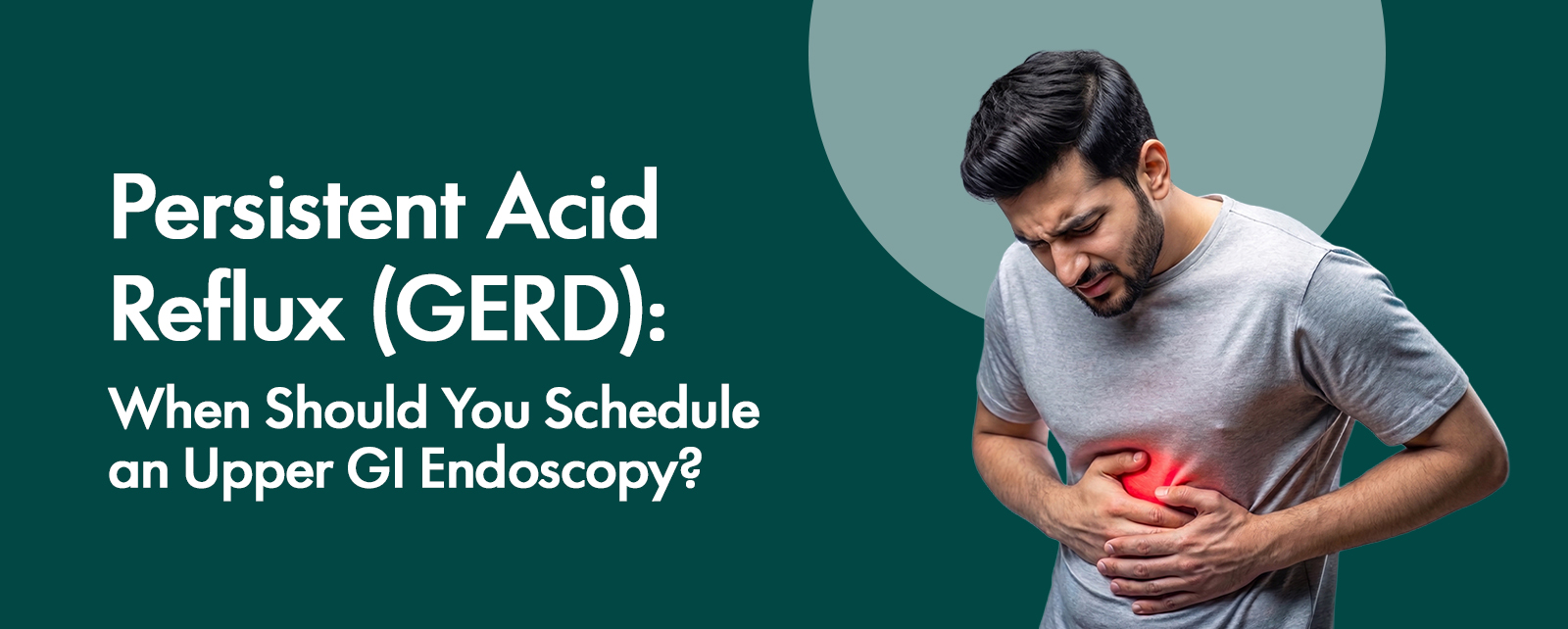
Persistent Acid Reflux (GERD): When Should You Schedule an Upper GI Endoscopy?
Virtually all people have at some time suffered acid reflux, which is the burning sensation starting in the stomach and moving to the chest, usually following a large meal or late-night snacking. It is infrequent and controllable for the majority of individuals. Acid reflux is turning into an almost daily experience of urban India that is ruining the sleep habits of many adults, restricting their diet, and silently stealing their quality of life.
Condition satisfies the clinical definition of Gastroesophageal Reflux Disease, or GERD, when reflux takes place at least twice a week over an extended duration. What distinguishes GERD and normal heartburn is not merely its frequency but its possibilities of structural damage to the oesophageal lining in the long term. Chronic symptoms should be carefully assessed at a qualified endoscopy facility in Delhi instead of continuing to take antacids that only suppress the symptoms without correcting the underlying pathology.
Knowledge of the Development and Persistence of GERD
GERD is a disease that comes about when the bottom oesophageal sphincter, which is the muscular valve that pits the oesophagus and stomach apart, does not close sufficiently after food has gone through, and as a result, it allows the gaseous acidic stomach contents to recline to the uphill. It may be a dysfunction that is temporary or chronic, and there are several reasons why it develops and continues.
The factors that aliver specialist in Delhior a gastroenterologist would consider in his or her evaluation include:
- Obesity and central adiposity raise the pressure within the abdomen and mechanically weaken the sphincter competence.
- Hiatus hernia, in which the portion of the stomach sticks over the diaphragm, breaking the anatomical barrier to reflux.
- Eating habits rich in fatty foods, caffeine, carbonated drinks, citrus, and chocolate, all of which decrease lower oesophageal sphincter tone.
- Smoking, that affects the mucosal defence mechanisms and diminishes the sphincter pressure.
- Some drugs, such as calcium channel blockers, nitrates, and anticholinergics, relax the sphincter as an adverse effect.
- A slow gastric emptying extends the time that the stomach contents containing acid can reflux.
Without appropriate research, GERD has a definite long-term risk, namely Barrett's oesophagus, in which the normal oesophageal lining is substituted with an intestinal-type epithelium due to chronic exposure to acid. Barrett oesophagus is a known precursor to oesophageal adenocarcinoma, and thus its identification and monitoring have clinical importance.
In Cases Where an Upper GI Endoscopy is Needed
H2 receptor antagonists and proton pump inhibitors have been shown to be effective in controlling the symptoms of GERD in most patients, and a medication trial is a fair first step. But the pills regulate the amount of acid secreted, but do not show what has already occurred to the lining of the oesophagus. Certain clinical conditions warrant such that direct referral to endoscopic assessment at an accredited endoscopy center in Delhi is the correct course of action instead of further empirical therapy.
Upper GI endoscopy is done when:
- The symptoms remain or recur even after a satisfactory trial on proton pump inhibitor therapy in usual dosing.
- The inability to swallow or having a feeling of food lodging in the throat or chest develops - dysphagia - which can be a sign of oesophageal stricture.
- Reflux symptoms are accompanied by unexplained weight loss, which is a cause for worry about a possible underlying malignancy.
- The patient is more than 45, and she complains of new-onset GERD, or she has a family history of oesophageal or gastric cancer.
- The symptoms would include regurgitation of blood or passing of dark, tarry stools that are indicative of upper GI bleeding.
- Reflux chest pain has not been properly studied to rule out cardiac aetiology.
- In a 24x7 emergency hospital in Delhi operations (Delhi), upper GI bleeding in the presence of severe GERD or oesophageal ulceration is an acute presentation that necessitates endoscopy intervention instead of scheduled outpatient assessment.
What to Expect of the Procedure and the Aftermath
Upper GI endoscopy is a minimally invasive diagnostic technique that is done with light sedation; the procedure usually lasts between 10 and 20 minutes. A camera on a thin and flexible tube is inserted through the mouth, down the oesophagus, stomach, and duodenum, giving a direct view of the mucosal lining.
The endoscopist is able to:
- Determine oesophagitis based on the Los Angeles Classification system, which determines the level of treatment.
- Check and biopsy the oesophagus of Barrett and grade dysplasia.
- Understand the anatomy of a hiatus hernia and determine its role in reflux.
- Perform pathological testing on suspicious lesions of mucosal biopsies.
- Conduct therapeutic procedures, e.g., oesophageal dilatation of strictures during the same session.
The recovery of an upper GI endoscopy is fast. The majority of patients are able to resume normal activity in a few hours, and mild discomfort in the throat subsides by the next day. When biopsies are taken, the results are generally made available in five to seven working days and discussed at a follow-up appointment.
Sri Balaji Action Medical Institute: Gastroenterology and Emergency Care Co-located
Sri Balaji Action Medical Institute is a fully equipped Institute of Gastrosciences based in Paschim Vihar, New Delhi, that provides upper GI endoscopy, colonoscopy, capsule endoscopy, high-resolution manometry, and interventional gastroenterology procedures. The institute offers an organised evaluation of GERD, surveillance programmes by Barrett, and automatic upper GI bleeding intervention by emergency endoscopy, with its 24-hour emergency service.
With hepatology, medical gastroenterology, and GI surgery all under a single roof, and a NABH-accredited history of providing more than 20 lakh patients with diagnostic and therapeutic services, Sri Balaji Action Medical Institute provides the diagnostic and therapeutic infrastructure that complicated gastrointestinal conditions demand.
Frequently Asked Questions
Q1. What is the duration of an upper GI endoscopy procedure in an endoscopy centre in Delhi, and is it necessary to be sedated?
This is done in light sedation, and usually lasts 10 to 20 minutes. The patients are followed up and released the same day, after a short period following the operation, and with minimal discomfort.
Q2. Does a liver specialist in Delhi also check GERD, or does the condition necessitate a separate gastroenterology appointment?
GERD assessment is in the field of gastroenterology. An integrated gastroenterology and hepatology institute is operated by a gastroenterologist or hepatologist with the knowledge of gastroscopy to treat both upper GI and liver diseases.
Q3. In which situations would a patient with GERD be in urgent need to visit a 24x7 emergency hospital in Delhi?
Vomiting blood, passing black tarry stools, severe chest pain, or sudden swallowing difficulties should be followed by immediate emergency examination since it is a sign of acute upper GI complications.
Q4. Does Sri Balaji Action Medical Institute have Barrett's oesophagus surveillance programmes for high-risk GERD patients?
Yes, the Institute of Gastrosciences offers systematic endoscopic follow-up of Barrett's oesophagus, such as scheduled follow-up endoscopy and biopsy regimens, contingent on the dysplasia grading and clinical risk profile.